This is the post where I try 18th century recipes, with intersting results...
But first a little background:
Me, my husband and a friend of us have a food blog where we cook and eat strange and more or less bizarre recipes from the 70's (link
here but the blog is in Swedish. The pictures may prove to be universally horrifying regardless).
One recipe, that we made TWICE in the last year, has reached almost a legendary status among us and our readers: Stuffed cabbage!

It's basically cabbage filled with minced beef that cooks for 2-2,5 hours. Served with butter OR horse radish
only. No potatoes, rice or anything.
It's, in short, an awful recipe and when we realised there was an 18th century version of the recipe in a digitised 1751 cookbook, we knew we had to make an 18th century themed meal (the book can be viewed in full
here. Search for "Elzberg". It is in Swedish, of course).
And we did.
This is me, the merry cook, posing outside before her evil deeds began:

The outfit is one I made for an event in March where we had the opportunity to dress down and portray the lowlier classes (which was great fun!). The jacket is made from striped linen and so is the petticoat. Under it I wear a similar but with narrower stripes.

I BADLY needed new under-petticoats so I'm glad I was more or less obliged to make these two. I'm going to shorten the one you see above and use it as an under-petticoat in the future.
Enough! Bring on the food!
We decided to make two dishes in addition to the cabbage (because it was very unlikely that it would be at all edible) and decided on
"Ferserad kalops" (i.e. minced kalops; kalops being a typical Swedish beef stew) and
"Shokolad-miölk af brynt miöl" (i.e. Chocolate milk made from browned flour).
The cabbage was going to boil for THREE HOURS so we started out with that...

It's harder than you think to make a cabbage hollow. And it can be quite dangerous but a spoon is a great help.

The excess cabbage was going to be finely chopped and used as stuffing and I quickly decided to use my not-so-historical kitchen machine for this task.

Until now, we've only had cabbage and more cabbage so let's see what happens if we introduce some other interesting ingredients... Like:

...breadcrumbs, nutmeg, currants, eggs, cream, milk, melted butter and salt...
As you can see in the picture, the cabbage was filled with this mixture (I tasted it at this point, and it wasn't bad at all! Sort of sweet. And cabbage-y)...

...then the "lid" was put in its place and secured with some string. Then it went into the water for three hours of smelling like cabbage normally does when boiling.
***
And we moved on to the minced beef thingies.
I must admit - the recipe called for beef that was supposed to be finely chopped, mixed with some suet and then chopped some more. How about - no? I just went for store-bought minced beef. So sue me.

Well, turned out this recipe originally was quite close to classic Swedish hamburgers: minced beef mixed with eggs, breadcrumbs and milk. The seasoning was a little unusual though: parsley and nutmeg, and some salt. Not TOO bad!

Just to prove that I've been cooking in stays for the first time!
Anyway, the beef was shaped into small patties that were to be placed in a larger pan on top of each other. I had a bad feeling about this but decided to stay true to the recipe.

Then water, butter and cloves was added. These hamburgers were to simmer in hot water rather than being fried, you see. The image below didn't make me more confident in this recipe...

Neither did this one, when they were nearly done:

Oh dear.
But things started to look better after we took them out of the pan. I had feared that everything would've merged into some horrible mush but my suspicions were unjust! The hamburgers looked... perhaps not tasty, but not like something out of an horror movie either!
Served on the table:

So what did they taste like, you ask?
Well, I'm sorry to have to tell you that they didn't taste
at all! They were completely devoid of any flavour which was really strange. I guess the water stole all their flavour away.
So - it wasn't bad but not good either (we used the leftovers a few days later in a spicy tomato sauce, though, so all's well that ends well!).
***
Curious how the cabbage is faring by now?
Well, after a mere hour, we started to realise that the bread in the filling was swelling a bit more than expected...

Oops. Exploding cabbage, anyone? The yellow is butter - lots of butter - because the recipe told us so.

Oh dear. Oh no.

This is what it looked like right after it was released from the pan. Can it get any worse? OH YES YOU BET!
You see, this cabbage was supposed to be served with a dressing/sauce made from cream, egg yolks and nutmeg...
It was looking great for a while; it even looked great until the moment the sauce was to be poured over the cabbage...
Then it scrambled and all hope was lost forever. Sensitive viewers are hereby warned:

This is just so wrong. But with all this work, everyone was very much obligated to have a little piece of it at least. We HAD liqueur available and there was a hospital nearby. No worries!
 Would you like a big or small..? Nevermind.
So - what it was really like?
To be honest, four out of five people found it pretty much revolting - even those who doesn't object to cabbage normally. Mostly because of the grotesque appearance of the dish and secondly because of the funny sweet flavour that almost made it more suitable for the dessert table (a dessert table in hell, that is).
I, for one,
almost liked it. Yes, it's true. I even cleared my plate. I may not have had a second helping, but overall, it was better than it looked.
Will I make it again? Ha ha ha. No.
***
Now there is time for the
actual dessert - Chocolate milk made from browned flour.
There is something very interesting about this dessert. Want to know what?
It doesn't contain chocolate!It's - basically -chocolate milk without chocolate! Chocolate for the poor. That's where the browned flour comes in, to give the "chocolate" a brown colour. Amazing.
So, according to the recipe, I started to brown the flour in a hot frying pan, making sure it didn't got burnt.

Yes, getting there but not quite brown enough!

I wanted the flour to get real brown but finally it started to smell funny so I quickly turned the heat off.
While the flour cooled off, I heated milk in a pan with sugar and a piece of cinnamon. When it began to boil, the flour was added little by little.

I was sure it was going to get lumpy but it didn't. Because the flour was more or less fried perhaps?

I continued to add flour until it got rather thick (and brown enough to pass for some kind of chocolate because I guessed that was what to aim for...) and finally poured it into a shallow bowl that I placed on the table. The guests then were served the "chocolate" in cups.

I had
no higher expectations about this one; in fact, I was sure it was going to taste like burnt flour and that would be that.
Surprise, surprise! This was quite nice and most of the guests agreed. It tasted of cinnamon and sweet milk - no hint of flour at all! It was a little on the thicker side so I should have been a little more careful when I added the flour to the milk but overall - a nice treat before bedtime, this was (or as the recipe concluded: "One can use it in the evening").
If you have read this far, you're awesome! Thanks for looking.
Here's how the recipe for the "chocolate" from the 1751 cookbook looks like:


 It's basically cabbage filled with minced beef that cooks for 2-2,5 hours. Served with butter OR horse radish only. No potatoes, rice or anything.
 The outfit is one I made for an event in March where we had the opportunity to dress down and portray the lowlier classes (which was great fun!). The jacket is made from striped linen and so is the petticoat. Under it I wear a similar but with narrower stripes.
 I BADLY needed new under-petticoats so I'm glad I was more or less obliged to make these two. I'm going to shorten the one you see above and use it as an under-petticoat in the future.


 Until now, we've only had cabbage and more cabbage so let's see what happens if we introduce some other interesting ingredients... Like:
 ...breadcrumbs, nutmeg, currants, eggs, cream, milk, melted butter and salt...
 ...then the "lid" was put in its place and secured with some string. Then it went into the water for three hours of smelling like cabbage normally does when boiling.
 Well, turned out this recipe originally was quite close to classic Swedish hamburgers: minced beef mixed with eggs, breadcrumbs and milk. The seasoning was a little unusual though: parsley and nutmeg, and some salt. Not TOO bad!
 Just to prove that I've been cooking in stays for the first time!

 Neither did this one, when they were nearly done:
 Oh dear.
 So what did they taste like, you ask?
 Oops. Exploding cabbage, anyone? The yellow is butter - lots of butter - because the recipe told us so.
 Oh dear. Oh no.
 This is what it looked like right after it was released from the pan. Can it get any worse? OH YES YOU BET!
 This is just so wrong. But with all this work, everyone was very much obligated to have a little piece of it at least. We HAD liqueur available and there was a hospital nearby. No worries!
 Would you like a big or small..? Nevermind.
 Yes, getting there but not quite brown enough!
 I wanted the flour to get real brown but finally it started to smell funny so I quickly turned the heat off.
 I was sure it was going to get lumpy but it didn't. Because the flour was more or less fried perhaps?
 I continued to add flour until it got rather thick (and brown enough to pass for some kind of chocolate because I guessed that was what to aim for...) and finally poured it into a shallow bowl that I placed on the table. The guests then were served the "chocolate" in cups.
 I had no higher expectations about this one; in fact, I was sure it was going to taste like burnt flour and that would be that.

 A beautiful fluffy cat (and some kid called Gabrielle Arnault) by Louis Leopold Boilly. 1813. The Louvre.
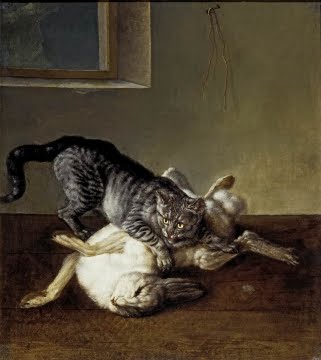
 But please enjoy this instead: Cat and Dead Hare, 1777, Ivan Fedorovich. Tretyakov State Gallery.
 Elias Martin, Landscape with a lake. Pushkin Museum of Fine Arts
 C A Staaff. 1870's illustration


